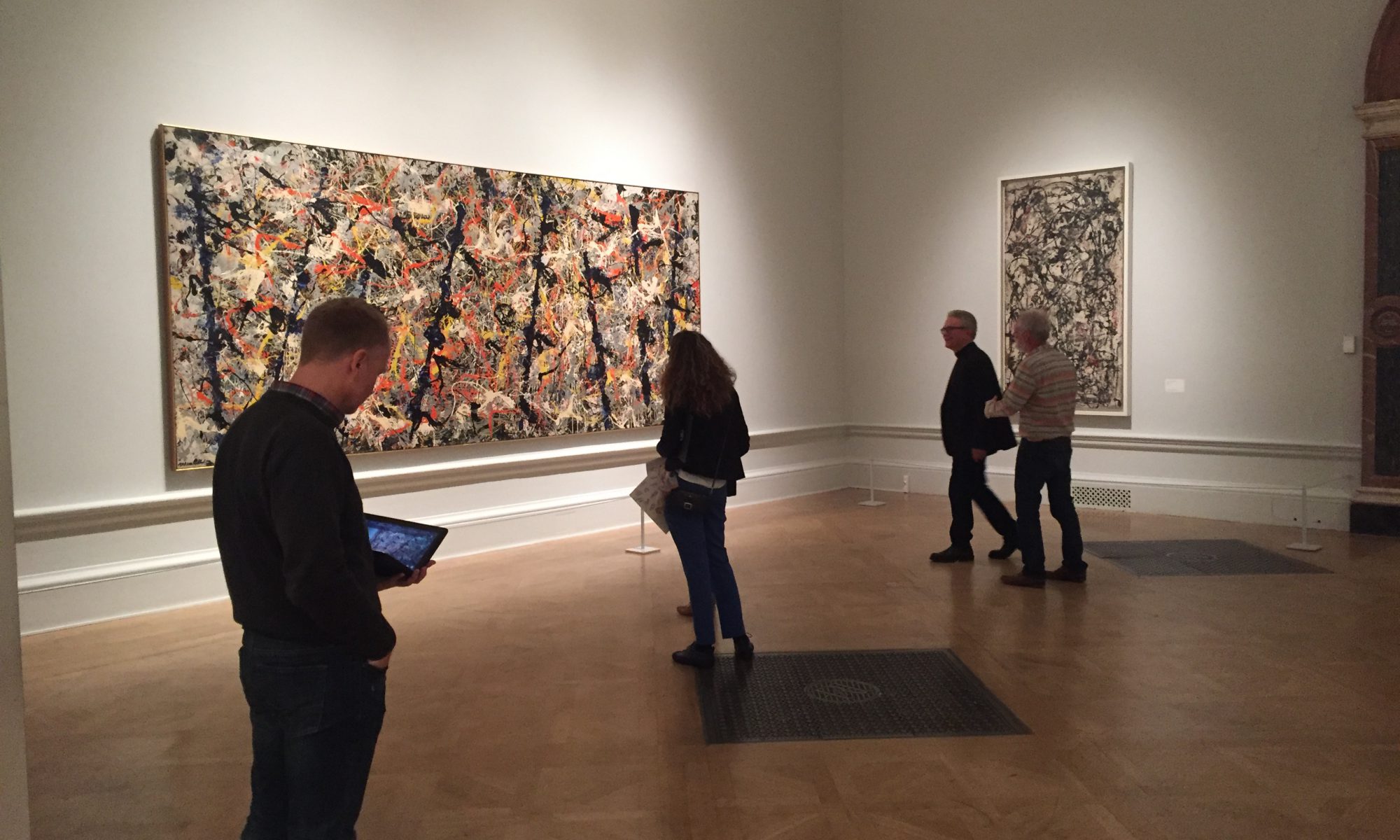
We recorded eye movements of 24 participants moving freely in the Royal Academy viewing two abstract Pollock paintings (‘Mural’ 1943, ‘Blue Poles’ 1952). In an attempt to characterise their exploration during an extended viewing time, our goal was to describe commonalities of gaze patterns. Spontaneous behaviour in museum settings shows extensive head and body movements leading to substantial gaze displacements across the large canvases.
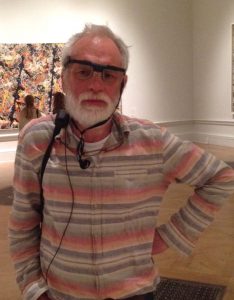
Participants were fitted with TG2 mobile eye tracker which samples gaze positions at 50 Hz and marks it in a video sequence of the scene camera, to be later mapped manually on a reference image of the painting.
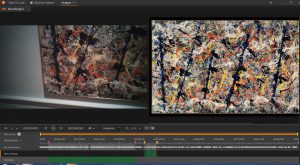
Analyses flow – step 1: Screenshot of Tobii Pro Lab analysis software (I-VT fixation detection algorithm): mapping fixation in scene movie frame (red circle) onto reference image (‘Blue Poles’).
After this initial analysis step, data can be visualised within Tobii Pro Lab, and can be exported to do data files, to be cropped for relevant episodes of the recordings during which participants explore the two painting, for further off-lone analysis with bespoke MatLab programs for advanced data analysis.